Shoulder Season on Nisyros: Which Weeks Still Work in October
On the second of October the boat from Kos had thirty people on it and the crater had six. Two weeks later a friend took the same crossing and found the tavernas in Mandraki closed except one, the bus to the crater running three times a day instead of six, and the hotel he had booked shut for the season without telling him. The difference between those two trips was fourteen days.
October is the best and most variable month on the smaller islands. The sea is warm, the light is good, the crowds are gone and the prices are down. It is also the month when the season ends in stages, and the stage your dates fall into decides what is open.
The four stages of an island October
The first ten days behave like an extension of September: everything open, ferries frequent, the sea at its warmest. The second ten days see the first closures, the boat schedule begin to thin, and the tavernas start to shorten their menus. The last ten days are a different island, with half the rooms shut and the ferry running four times a week.
After that, November, which is the real closed season. A trip planned for the 25th of October and a trip planned for the 5th are not comparable, and any advice about October travel that does not distinguish between them is not advice.
What the first week buys
Early October is the value sweet spot on the small islands. The August rate of 85 becomes 50, the sea is around 24 degrees, and every taverna is still running. The boat from Kos still has a morning and an afternoon sailing, and the bus to the crater keeps its summer frequency.
It is also the point at which the island empties. The day-trippers from Kos come mainly in July and August, and by the first week of October the crater at nine in the morning is quiet. That combination of full services and no crowds is the reason people who know the islands travel in this week.
What the third week costs you
By the third week, the ferry schedule is thinner and the accommodation is half closed. The rooms that stay open do not necessarily discount further, because the owner is covering the cost of staying rather than filling space. The tavernas that remain open are the ones the residents use, which is good for the food and limited for the choice.
The bus to the crater becomes unreliable, and the excursion boats stop. Anyone without a car is dependent on a taxi that may be one vehicle serving the whole island. This is manageable and it needs planning rather than improvising.
The sea and the swimming
The water in early October is at its annual warmest, having had all summer to heat. By the third week it is still swimmable and noticeably cooler, and by the end of the month it is a decision rather than a habit. The air temperature drops faster than the water, which makes the first minute bracing and the next twenty pleasant.
There is also more wind. October is a month of transitions and the first autumn storms arrive, usually as a day or two of strong wind followed by calm. A beach that faces north is unusable on those days and a cove that faces south is perfect, which is worth knowing before choosing where to stay.
Accommodation and the closed-for-season problem
The specific hazard of late October is booking a room in a property that closes on the 15th. The booking platform will take the reservation, the owner may not check the messages, and the arrival finds a locked door. This happens on the small islands every year and it is entirely avoidable.
Book direct in late October, and confirm by phone or message two days before travelling that the property is open and expecting you. Ask for a mobile number rather than an email, because the email may be checked monthly in the low season.
The crater, the villages and the hours
The archaeological site at the crater keeps opening hours that shorten in October, and the ticket office may close for lunch. The museum in Mandraki and the small one in Nikia both operate on reduced hours and may open only if someone calls ahead. The monastery is open in the mornings.
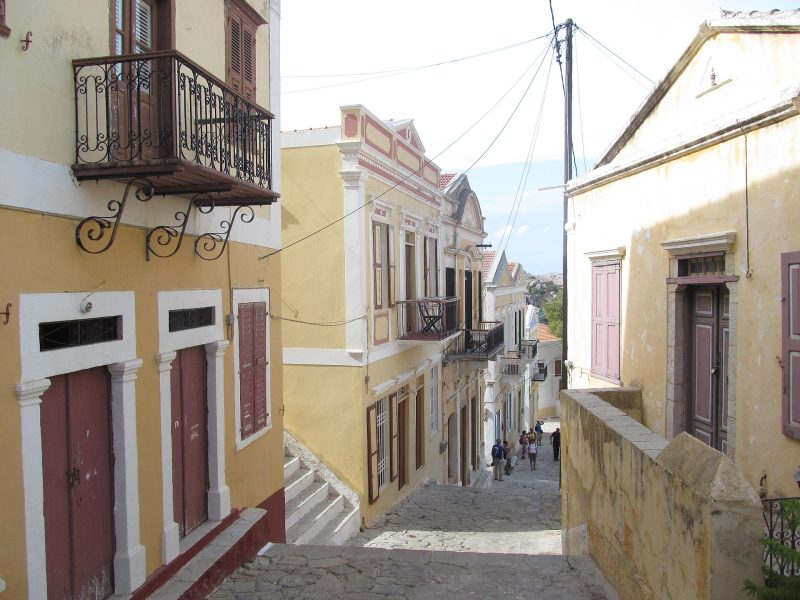
The villages are the reliable part. Mandraki has residents all year and the square is used in October for the ordinary business of a village. Nikia is quieter, with more shutters down, and the café may be open at weekends only.
Ferries, and the connection to Kos
The Kos crossing is short and it is the lifeline. In the first half of October it runs at least daily and often twice. In the second half it can drop to four or five a week, and the afternoon return may disappear, which turns a day trip into a night.
Anyone staying more than two nights should check the schedule for the specific week rather than the month, because the operator adjusts it in response to demand and the adjustment happens about three weeks ahead. Photograph the timetable at the port on arrival and plan the departure from that.
What to pack differently
A windproof layer, long trousers for the evening, and shoes that cope with a wet path. October on a volcanic island is warm at noon and cool at night, and the wind on the crater rim at nine in the morning is genuinely cold. Swimming things still earn their place in the first half of the month.
A torch is worth having for the walk back from dinner, because the lanes in Mandraki are lit unevenly and the power in a small village does occasionally go out. This is not a warning, it is a practical note that saves a stumble.
The day-trip trap in late October
In the second half of the month the afternoon return to Kos can disappear without the morning sailing changing, which silently converts a day trip into an overnight. Visitors arriving on the morning boat with a return ticket in hand sometimes find the return leg has been moved to the next morning, and there is nowhere booked to sleep.
Check the return sailing at the ticket office before leaving the port, not the outbound time on the ticket. If the return is the next day, either book a room at the port before walking into the village or take the earlier boat back, because finding a bed at nine in the evening in a half-closed village is a poor use of an evening.
What the resident population does to a visit
By mid-October the island’s population is close to its winter level, which on Nisyros is under a thousand people spread across three villages. That changes the character of a stay more than the weather does. The square in Mandraki fills with children in the afternoon, the fishing boats go out on days when the sea allows, and the conversation in the taverna is not about the season.
For a visitor this is either the best thing about October or a reason to come in June. It is worth deciding before booking, because the island does not pretend to be anything other than what it is at that moment, and the visitor who arrives expecting a resort in the last week of the month will be disappointed by a place that is simply living.
Deciding between the two halves of the month
Choose the first ten days if the trip depends on boats, buses and a choice of restaurants. Choose the third week if the plan is walking, a quiet room and one taverna, and accept that the island will be operating at a reduced tempo. Both are good trips and they are not the same trip.
What matters is booking the right one for the intention. The mistake is arriving in the last week expecting the first week, and it is a mistake that one phone call to the room owner, in advance, prevents entirely.
Photograph: Wikimedia Commons (CC BY 3.0) · source file

Confessor Santos
Writes about island guesthouses, ferry timetables and the week a room price finally drops.
Keep reading
Nearby landings
Booking Late Versus Early: Island Room Rates in the Quiet Weeks
Two friends booked the same room on the same island for the same three nights in late September.…
What Stays Open on a Greek Island in November
In the first week of November a traveller arrived on a Cycladic island with a room booked and…
Why the Last Week of September Beats the First Week of June
The first week of June and the last week of September are four months apart and almost identical…