Planning Around the Meltemi: Wind, Ferries and Beach Choice
On the fourth day of a week in the Cyclades the wind arrived, and by nine in the morning the ferry to the next island was cancelled, the beach was a sandstorm, and the taverna had moved its tables inside. It lasted three days. The people who had planned for it went walking on the sheltered side of the island and had a good time. The people who had not spent three days in a room looking at a forecast.
The meltemi is the dominant weather system of the Aegean summer, a northerly wind that blows for days at a time, and it is the single most important thing to understand about planning a trip to the Greek islands between June and September.
What the meltemi is and when it comes
The meltemi is a steady northerly wind, force five to seven, sometimes eight, which blows down the Aegean from the Black Sea region. It is most common in July and August, when it can blow for a week, and it appears in June and September in shorter bursts of one to three days.
It is not a storm in the usual sense. It is a persistent wind under a clear sky, which is why it catches people out: the weather looks perfect and the sea is too rough to sail and too rough to swim on the north coast.
How it affects the ferries
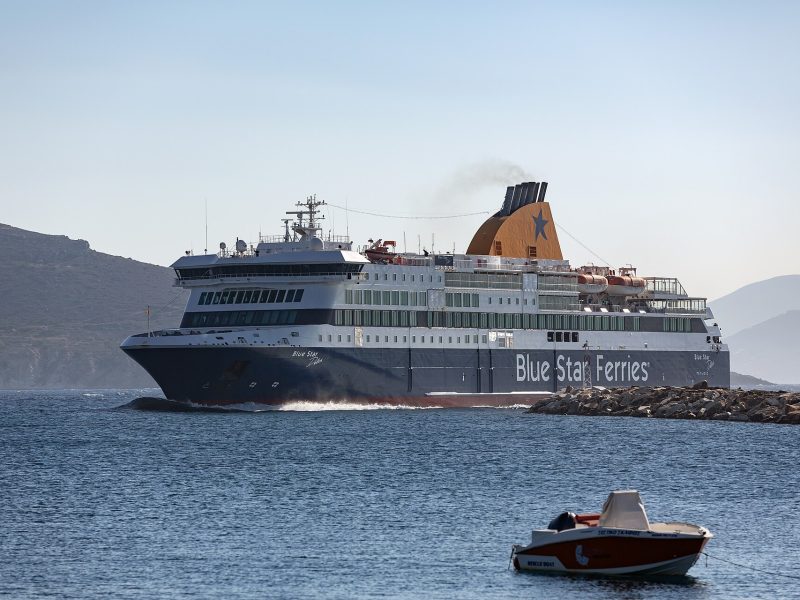
Large conventional ferries sail in most meltemi conditions and are rarely cancelled. Fast catamarans and small boats are cancelled much more readily, because they are less comfortable and less safe in a short sea. Hydrofoils, where they still run, are the most vulnerable.
The practical rule is that during a meltemi the conventional ferry is your friend and the fast boat is a gamble. Anyone whose itinerary depends on a fast connection in July or August should have a slower alternative in mind.
Which islands are sheltered
The meltemi funnels through the channels between islands and hits the north and east coasts hardest. An island with a harbour on the south or west coast keeps its boats running when a neighbour’s north-facing port is closed. An island with two ports, one on each side, is much more resilient than one with a single exposed harbour.
This is worth checking before booking, particularly for the smaller islands with one port. A port that faces north on a meltemi island is a port where boats do not come in, and the ferry schedule in a windy week reflects that.
Which beaches work and which do not
North-facing beaches are unusable in a meltemi: the wind comes straight onshore and the sand is horizontal. South-facing beaches are calm and often the only swimmable water on the island. East and west coasts fall in between and depend on the angle of the cove.
The local knowledge is decisive here. Ask which beach people use when the wind is up, and go there. On most islands there is a well-known answer involving a twenty-minute drive and a cove that faces away from the weather.
What it does to a walking day
The meltemi is excellent for walking, because it removes the heat. A climb that is punishing in still air is comfortable in a force five, provided the path is not exposed on a ridge. The sheltered side of the island is where to walk, and the island’s old paths often run along valleys rather than ridges.
The danger is the exposed sections. A ridge path in a force seven is a fight, and a hat becomes a projectile. Take the low routes on a windy day and save the high ones for a calm morning.
How to read a forecast on an island
The forecast that matters is wind speed and direction, not the weather icon. An app showing sun and a force six is telling you that the beach will be empty and the boats may not run. Look at the wind figure and the direction arrow rather than the picture.
The forecast for the channel between islands is more useful than the forecast for the island itself. Several marine forecast services give wind by sea area, and those are the numbers the ferry operator is looking at.
How long it lasts and how to plan around it
A typical meltemi lasts three days, with the strongest in the middle. Forecasts three days out are reasonably reliable for the general pattern and unreliable for the exact strength. The practical planning response is to build a trip with two flexible days and to expect at least one of them to be windy.
The worst plan is one that requires a boat on a specific day in the middle of a July week. The best is one where a cancelled boat costs a beach day rather than an island.
What to do on a meltemi day
Swim on the sheltered coast, walk in the valleys, eat a long lunch, visit the archaeological site that has been on the list, and read. The islands are full of things that are better in wind than in still heat: the hill villages, the museums, the windmills, the inside of a taverna with a fire in October.
What not to do is go to the north beach because it is the famous one. It will be a sandblasting, and the people there will be leaving as you arrive.
The upside, which is real
The meltemi clears the air and keeps the temperature bearable. A meltemi week is a week without the crushing still heat of August, and the light is extraordinary: sharp, clear, and full of movement on the water. The photographs from a windy day are better than the photographs from a still one.
It also empties the beaches that face the wind, which on some islands means the best beach in the area is deserted while everyone crowds into the one sheltered cove. Anyone who reads the wind correctly gets the good beach to themselves.
What the wind does to a water taxi
Water taxis stop before the ferries do, because a small open boat in a force five is not a trip anyone wants to make. On a meltemi day the coves that need a boat become inaccessible, which is another argument for choosing accommodation near a walkable beach rather than a famous one.
Ask the skipper in the morning rather than at the quay at ten. The answer will be honest and it will be given early, and it saves a walk to a jetty where the boats are all tied up and covered.
The three-line plan
Check the port orientation of every island on the itinerary. Book conventional ferries rather than fast ones in July and August. Keep one day unplanned for every three planned. Those three lines cover almost everything the meltemi can do, and they cost nothing to apply.
The couple who walked on the sheltered side for three days had read the forecast before they booked the trip, and had chosen an island with a south-facing port. The people in the room looking at the app had booked a fast boat on a north coast. The wind was the same for both.
Photograph: Wikimedia Commons (CC BY-SA 4.0) · source file

Confessor Santos
Writes about island guesthouses, ferry timetables and the week a room price finally drops.
Keep reading
Nearby landings
Two Islands in Five Days: A Route That Survives a Delay
Five days, two islands, one ferry connection between them and a flight out of the second. That was…
Travelling With a Child on Island Ferries: Seats, Food and Timing
A four-hour crossing with a five-year-old and a two-hour delay produced, by the third hour, a child asleep…
A Short Trip With a Late Arrival: The First Night Problem
The flight landed at nine at night, the ferry left at six the next morning, and the room…