Arriving at a Popular Cove Before Ten: Timing on Three Islands
At half past nine in the morning there were eleven people on a beach that would hold four hundred by noon. At ten the first boat arrived with thirty. By eleven the excursion boats were running a shuttle from the port and the water was full of people and the shade was gone. The difference between the morning and the afternoon was two hours of sleep and a decision made the night before.
Timing is the cheapest and most effective crowd-control measure available on the Greek islands, and it works on the same principle everywhere: the transport delivers people in batches and the batches start at ten. Being there before the first batch is the whole strategy.
Why ten is the dividing line
Boats leave the port at ten because that is when the day-trippers have finished breakfast and the water taxis have fuelled. Buses run on a schedule that reaches the beaches between ten and half past. The excursion boats from a neighbouring island arrive around eleven. Everything converges on the same two hours.
Before ten, the beach belongs to the people staying nearby, the swimmers, and the man raking the sand. After ten it belongs to the timetable. Anyone who has watched a quiet cove fill in twenty minutes understands the mechanism immediately and plans around it for the rest of the trip.
The three islands and what each taught
On Symi the water taxis to the west coast leave at ten and the first one fills with thirty people, so the cove at Agios Georgios is quiet only until the first boat lands. On Milos the buses to Sarakiniko run from nine and the first one arrives full. On Folegandros the boats to Katergo leave at eleven and the beach is empty until then, which is a different pattern with the same result.
The pattern differs by island and the principle does not. Find out when the first boat or the first bus leaves, and be on the beach an hour before it arrives. On most islands that means eight, which is earlier than it sounds and worth the alarm.
What early actually costs
An eight o’clock start means breakfast at seven, which on a small island means a bakery rather than a terrace. It means carrying water and food, because the taverna opens at eleven. It means the first swim is in water that has had all night to cool, which is bracing rather than warm.
The return is the compensation. Leaving at one, when the beach is at its fullest and hottest, means a long lunch in the shade and an afternoon free. The people who arrived at eleven are still there at four, sunburnt and queuing for the boat. The early risers have already had their day.
The light, which is the other reason
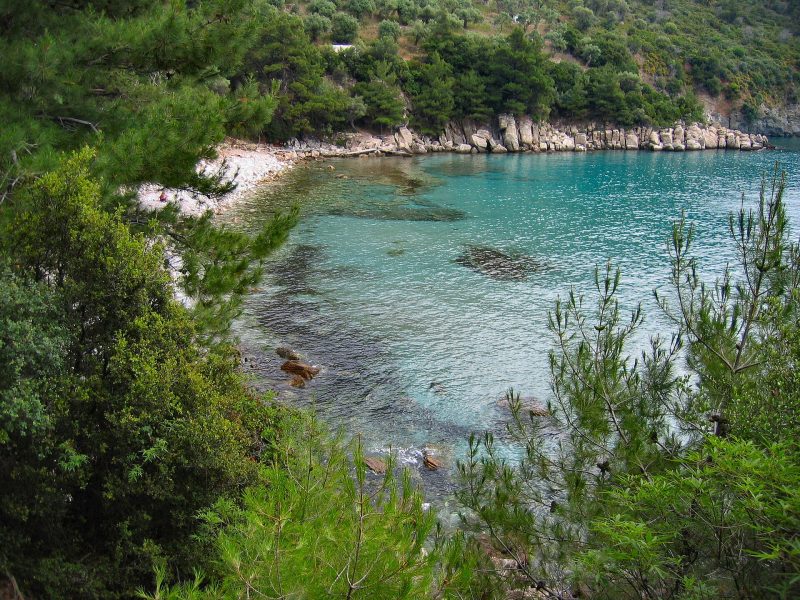
Morning light on the water is flat and clear, and the colours in the shallows are visible in a way they are not at noon. Anyone swimming with a mask sees the bottom properly before the sun is high, and the photographs taken at eight need no editing.
There is also the practical matter of shade. A cove with cliffs on one side has shade in the morning and none at midday, because the sun moves. Arriving early means sitting in the shade of the cliff rather than paying twelve euros for a sunbed under a straw umbrella.
The popular beaches and how they behave
A popular beach with a car park, a taverna and a bus service fills from ten and empties from five. A popular beach reached by boat fills in the two hours around the excursion and empties between them, which means there can be a quiet window in the middle of the day between the morning and afternoon boats.
That gap is worth knowing about. On islands with an excursion that goes to two beaches, the first beach is busy from eleven to one and the second from two to four, and a swimmer who reads the pattern can have either one quiet with a small adjustment.
The sunset and the second window
The other quiet window is after five, when the day-trippers have gone back and the light turns gold. The water is at its warmest, the beach is in shadow, and there are twenty people instead of four hundred. On beaches that face west this is the best hour of the day.
The return is the issue. A boat-only beach cannot be enjoyed in the evening unless a private boat is arranged, and the last scheduled boat is usually around six. Walkable and road-accessible beaches are the ones that work at sunset, which is another argument for choosing accommodation near one.
What to bring when arriving early
Water, food, a sunshade and shoes for the walk. The taverna may not be open, the shop will not be, and the sunbed man arrives at ten. A beach umbrella and two litres of water turn an eight o’clock arrival from a gamble into a plan, and they cost less than one sunbed for a day.
A light long-sleeved layer is worth having for the first hour, because the morning wind on an exposed cove is cool even in July. It is also the thing that makes sitting still at eight in the morning pleasant rather than a decision to leave.
The people who get there first
The early arrivals on an island beach are a recognisable group: the swimmers who come every morning, the older residents who walk the coast path, the occasional diver. They are worth talking to, because they know which part of the cove has the sand and which has the rocks, and they know where the current runs.
They also set the tone. A beach with twelve quiet regulars at eight in the morning is a different place from the same beach with a boat unloading at eleven, and the difference is not only the number of people. It is the volume and the pace and whether anyone is selling anything.
The beach that is better in the afternoon
Not every beach rewards an early start. A cove facing east has the sun from six and is in shadow from four, which makes the late afternoon the wrong time and the morning perfect. A cove facing west is the opposite: cold and shadowed at eight, warm and golden at six.
Orientation decides the timing, and orientation is visible on any map. Before setting the alarm, work out which way the cove faces. On a small island with coves on both coasts, that single check means every beach day is spent at the right one at the right hour instead of learning by trial.
Making it a habit rather than an effort
The first early start is difficult and the second is easy, because the reward is immediate and the cost is one hour of sleep. After three days the pattern establishes itself: bakery at seven, beach at eight, swim before the boat, lunch at one, and the afternoon in the shade.
That shape of day is why people return to the same island for twenty years. It is not a secret and it does not require a guide. It requires knowing when the first boat leaves, and being on the beach before it does.
Photograph: Wikimedia Commons (CC BY-SA 4.0) · source file

Confessor Santos
Writes about island guesthouses, ferry timetables and the week a room price finally drops.
Keep reading
Nearby landings
The Nude Beach Question: Signage, Access and Local Norms
On a small island in the Cyclades a couple walked twenty minutes from the port to a cove…
Shade, Wind and the Afternoon Switch on an Island Beach
By half past two the beach had reversed. In the morning everyone had been on the left side,…

Snorkelling From the Shore: Where the Rocks Actually Are
The mask fogged, the water was two metres deep for thirty metres, and there was nothing to see…