Snorkelling From the Shore: Where the Rocks Actually Are
The mask fogged, the water was two metres deep for thirty metres, and there was nothing to see but sand and one unfortunate fish. The beach was beautiful and the snorkelling was empty, and the reason was visible from the shore to anyone who knew what to look for: there was no rock. On the next cove along, a hundred metres of dark boulders ran out into the water and the same mask, on the same afternoon, showed five species in the first minute.
Snorkelling from the shore on a Greek island is not a matter of finding a good beach. It is a matter of finding the right substrate, and the substrate is visible from above, from the shore and on any satellite image. Once you can read it, every island becomes a series of good and bad spots that are obvious in advance.
What fish need, and therefore where they are
Rock, weed and shadow. A sandy bottom with clear water is a desert, and the Aegean’s sandy beaches are beautiful and empty underwater. Boulders, a drop-off, a line of reef or the shaded side of a cliff hold the algae that small fish eat and the crevices that larger ones hide in.
The best spots are where two types of bottom meet: rock and sand, or weed and gravel. Predators patrol the boundary and grazers work the rock, and the edge is where the density is highest. This is true everywhere and it is why the best snorkelling is usually not in the middle of a bay.
The three shore structures that work
The first is a rocky headland at the end of a beach, where the sand gives way to boulders and the water deepens quickly. The second is a flat rock platform with a drop-off, which is common on volcanic islands and which gives immediate depth. The third is a harbour wall, which is artificial and excellent, because the stones are piled loosely and there is shade under the boat moorings.
Harbour walls are the most underrated. Any fishing harbour with a mole has more life along its outer face than most beaches, and it is reachable from the quay without a boat. Ask permission before swimming inside a working harbour and stay well clear of the moorings and the propellers.
Reading the water from the shore
Dark patches in shallow water are weed or rock. Uniform green-blue is sand. A change of colour with a sharp edge is a drop-off, and the darker side is deeper or weedier. Seagulls working an area and terns diving are both signs of small fish near the surface, which means something larger underneath.
Polarised sunglasses make this much easier, and a walk along the shore with them on will identify every structure in the bay in ten minutes. That ten minutes is the whole method and it costs nothing.
The coves where it is best and why
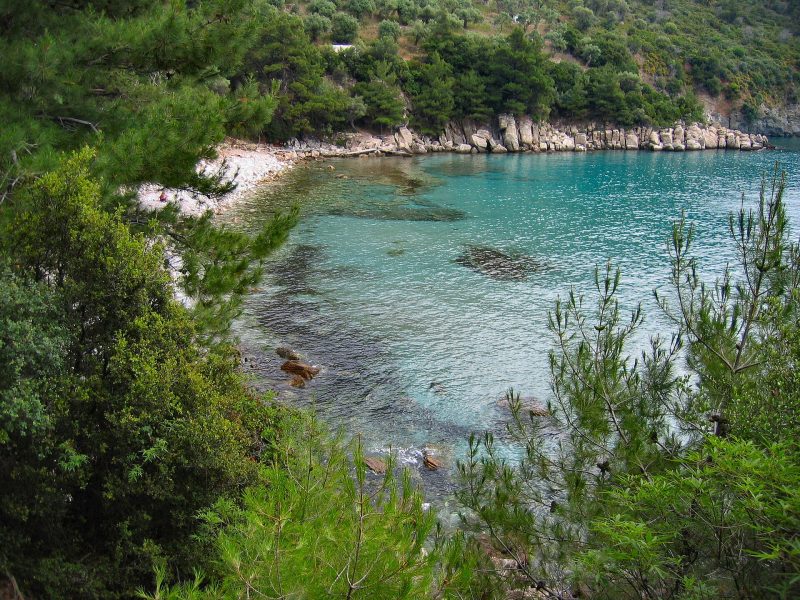
The clearest water is in coves with rock walls and no sand, which are usually the ones with no road. A cove with a pebble beach and cliffs on both sides has visibility of twenty metres on a calm day and structure along both flanks, and the swimming is a slow traverse from one side to the other.
Volcanic islands have an advantage, because the rock is irregular and full of holes. Nisyros, Milos and Santorini all offer bottom structure that limestone islands do not, and the difference in fish life is visible in the first two minutes.
The equipment that matters
A mask that fits, which means trying it on before buying and checking the seal against the face without a strap. A snorkel with a simple valve. Fins, which add range and comfort and are the one item people skip and then regret. A rash vest, which is better than sunscreen for a long session.
Everything else is optional. A camera is nice and a torch is useful under ledges and in the harbour, and neither is essential. The single most important piece of equipment is a mask that does not leak, and a cheap one that fits beats an expensive one that does not.
The safety rules that are not optional
Never snorkel alone, and never in a place where no one can see you from the shore. Look up every thirty seconds to check where you are, because it is very easy to drift a hundred metres along a cliff without noticing. A bright snorkel or a rash vest in a bright colour is worth more than any other safety purchase.
Watch the wind and the boat traffic. A cove with excursion boats arriving at eleven is not a safe place to be at eleven, and a bay with a strong offshore wind will carry a swimmer out without any sensation of being carried. Ask locally about currents, which on some islands run hard through the channels between coves.
The times of day that work
Early morning is the best light and the calmest water, and the fish are feeding. Late afternoon is the second best, when the light is low and the shadows are long, and the wind usually drops. The middle of the day has the worst light, the most boats and the most people.
Tide is negligible in the Aegean, which simplifies matters, and the wind is the dominant variable instead. A day of flat calm after a day of wind gives the best visibility, because the sediment has settled. That is worth waiting for if the trip is long enough.
What you will and will not see
The Aegean is not a tropical reef and the expectation matters. What there is: dense schools of small silver fish, wrasse, bream, octopus under stones, sea urchins in the crevices, starfish on the sand, and occasionally a moray in a hole. What there is not: coral in colour, large groupers near the shore, or turtles except in specific bays.
That is enough for a good hour and it rewards patience over range. A snorkeller who stays in one twenty-metre area for forty minutes sees more than one who swims a kilometre looking for something better, and the second person usually ends up over sand with nothing.
The rocks that are dangerous
Sea urchins are the main hazard and they are common on rocky shores in the Aegean. They sit in the crevices and on the shaded faces, and a foot or a hand placed without looking will find them. Shoes with a sole are the answer, and vinegar is the traditional treatment rather than tweezers.
Weaver fish and the occasional jellyfish are the other two. The weaver sits in sand in shallow water and a sting is painful for hours; the treatment is hot water. Jellyfish in the Aegean are usually mild and occasionally not, and the local advice on which week they arrive is more reliable than any general rule.
Making it part of the day rather than the point of it
The best use of snorkelling on an island is as a thirty-minute addition to a beach day rather than a separate expedition. Arrive early, swim the headland while the water is calm, then sit and read. That pattern needs no boat, no guide and no equipment beyond a mask and fins.
It also means the equipment has to be light enough to carry on a walk, which argues for a mask and a short pair of fins rather than a full kit. On an island where the best coves require a path, the kit that gets used is the kit that fits in a day bag.
Photograph: Wikimedia Commons (CC BY-SA 3.0 gr) · source file

Confessor Santos
Writes about island guesthouses, ferry timetables and the week a room price finally drops.
Keep reading
Nearby landings
The Nude Beach Question: Signage, Access and Local Norms
On a small island in the Cyclades a couple walked twenty minutes from the port to a cove…
Shade, Wind and the Afternoon Switch on an Island Beach
By half past two the beach had reversed. In the morning everyone had been on the left side,…
Arriving at a Popular Cove Before Ten: Timing on Three Islands
At half past nine in the morning there were eleven people on a beach that would hold four…