Which Coves Are Walkable From the Port and Which Need a Boat
The map showed six beaches within a few kilometres of the port and no distinction between them. Two were a fifteen-minute walk on a path. Two were a forty-minute climb on a road with no shade. One needed a boat and one needed a boat and a scramble. We discovered this over three days in the wrong order, and the day we walked to the third one in midday heat was the day we learned to ask before leaving the room.
Beach access is the most useful thing to establish on the first morning of an island stay. The distance on a map tells you nothing about the gradient, the surface or the shade, and the difference between an easy cove and a hard one is often a single headland.
The three kinds of access
Walkable means a path or a minor road within twenty minutes, with somewhere to leave a towel. Road-accessible means a vehicle can reach it or near it, which includes everything with a car park and everything a bus serves. Boat-only means exactly that, with the practical addition that the boat may be a scheduled water taxi or a hired one.
Most islands have a mix, and the mix is the reason a car-free week works on some islands and not others. Establishing which category each beach falls into on the first day turns the rest of the week into a series of choices rather than a series of surprises.
What a walkable cove looks like
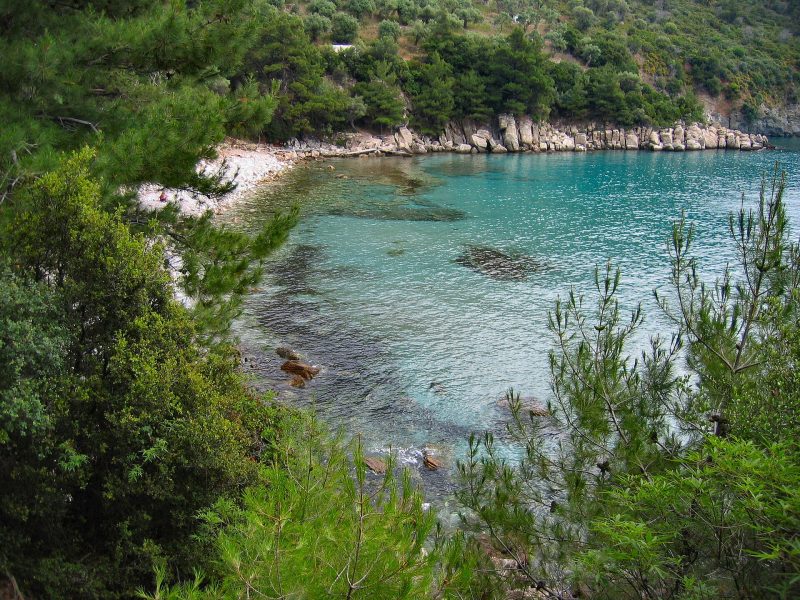
A walkable cove is usually within a kilometre of the village, on a path that is either paved or well-worn, and it usually has a small taverna or a beach bar in season. The tell is the presence of a rubbish bin and a shower, which means the municipality has decided people go there.
The best walkable coves are not the ones nearest the port. They are the ones fifteen to twenty minutes out, past the first headland, where the day-trippers do not bother and the locals go in the evening. Ask the room owner which beach they swim at, and go there.
The road that looks short on a map
An island road that switchbacks up a hill is twice as long as its distance and takes three times as long as the map suggests. A beach two kilometres away on a road with a two-hundred-metre climb is a forty-minute walk in the heat, not a twenty-minute stroll, and the return is worse.
The way to check is to look at the contour lines rather than the road. If the road crosses three or more contours between the village and the beach, it is a climb. On most island maps the contours are subtle and the gradient is not, and the lesson is learned once.
Shade, water and the walk that fails
The walkable coves are the ones with shade on the path for at least part of the way. An exposed path is fine at eight in the morning and dangerous at two in the afternoon, and a cove that is a pleasant walk at breakfast is an endurance test after lunch. This is why the same beach can be a fifteen-minute stroll and an hour of misery depending on the hour.
Carry more water than the walk seems to need. The return is uphill and the sun is behind you, and the number of people who run out on a twenty-minute path is surprising. A litre per person for a return walk of under an hour is the minimum in summer.
Where the boats go and what they cost
A scheduled water taxi from the port to a cove costs between five and twelve euros each way and runs a few times a day in season. A private hire costs from sixty to a hundred for the boat. The arithmetic favours the taxi for one or two people and the private hire for four or more.
The advantage of the boat is not only access. It is the arrival: a cove seen from the water and entered at the beach rather than down a path is a different experience, and the beaches that require a boat are the ones that stay quiet. The disadvantage is the return time, which is fixed and does not care that you have just fallen asleep.
The scramble, and where to stop
Some coves are reached by a path that ends in a scramble over rocks, and some of those are worth it and some are not. The rule is that a scramble with hands and a drop beside it is not a beach access, it is a hike, and a hike with a towel and no shoes is a bad plan.
Ask two questions: is there a rope, and is there a place to put a bag at the bottom. A rope means the municipality or a regular has decided it is used. A place for a bag means people swim there. Neither means it is a viewpoint rather than a beach.
The timing that changes a beach
Every accessible beach on a small island is quiet before ten and busy after eleven, because that is when the boats and the buses arrive. The walkable coves fill later than the road-accessible ones, which is another argument for walking. The boat-only coves are quiet all day until the excursion arrives, which is usually around eleven and lasts two hours.
Arriving at eight means having the beach to yourself for two hours, which is most of the value of a beach day. Arriving at eleven means sharing it with everyone, and the difference between those two experiences is entirely a decision made the night before.
The coves that are not worth the effort
Some coves are beautiful in a photograph taken from above and ordinary at sea level, and the effort of getting there is not repaid. This is usually because the beach is a narrow strip of pebbles at the foot of a cliff with no shade and no flat ground, and the photograph was taken from a boat.
The tell is the absence of any facilities at all and the presence of a dramatic photograph. A beach with a taverna has been judged usable by someone who lives there. A beach with nothing may be a swimming spot rather than a beach, which is fine if that is what you want and disappointing if you have walked an hour with a bag.
The paths that are not on the map
Most islands have a network of old mule paths that connect the villages to the coast, and these are often the fastest way to a beach that the road takes a long way round to reach. They are not always marked, they are usually not on a phone map, and the room owner will describe them in two sentences that are more accurate than any app.
The ones worth asking about are the ones that leave from the edge of the village rather than from the port, because the port paths have been replaced by roads and the village paths have not. A path that starts behind a church and ends at a cove in thirty minutes is the single best piece of local knowledge available on an island, and it costs one question.
Building a week around access
Two walkable coves, two road-accessible beaches and one boat trip is a good week on a small island. That mix gives four days without a vehicle and one day that feels like an excursion, and it avoids the trap of spending the whole week in transit between beaches that are all in the same photograph.
The plan should be built from the room outwards rather than from the map. Where the room is determines what is walkable, and what is walkable determines the shape of the week. On an island four kilometres wide, that is the only piece of planning that matters.
Photograph: Wikimedia Commons (CC0) · source file

Confessor Santos
Writes about island guesthouses, ferry timetables and the week a room price finally drops.
Keep reading
Nearby landings
The Nude Beach Question: Signage, Access and Local Norms
On a small island in the Cyclades a couple walked twenty minutes from the port to a cove…
Shade, Wind and the Afternoon Switch on an Island Beach
By half past two the beach had reversed. In the morning everyone had been on the left side,…

Snorkelling From the Shore: Where the Rocks Actually Are
The mask fogged, the water was two metres deep for thirty metres, and there was nothing to see…